Sunday, September 11, 2022

Santa Fe's Passenger F3s in Victorville, and Completing the Mainline Loop in Staging

This time we'll take a look at Santa Fe's passenger F3 diesel sets, all of which pulled passenger trains through Victorville, and then we'll look at the completion of the double-track mainline around the lower staging deck.

The Santa Fe's passenger F3 ABBA sets arrived in three batches, each looking a little different from the others.  The first batch arrived in Nov. 1946, and they were numbered 16-21.  They had the early, classic F3 appearance ("Phase 1"), with three portholes on the A unit sides, chicken wire over the upper grille area, high fans on the roof, and a pair of dynamic brake grilles on the roof behind the cab.

Here is Stan Kistler's great photo of set #19 when one month old (Dec. 1946): 

At this time they had only the high headlight (no gyro light), and the red warbonnet paint swept all the way back around the 2nd porthole.  The sides were painted silver, as stainless steel was not yet available.  This first batch of F3s kept their long warbonnets despite later changes to the carbodies.

Chard Walker shot set #20 bringing the eastbound Chief through the Upper Narrows and past the Rainbow Bridge in Victorville in April of 1947:


During 1948 this batch of F3s were converted to "Phase 2 Early," with the middle porthole removed and chicken wire now running between the first and third portholes over new carbody openings on the A units.  Santa Fe also moved the headlight lower on the nose and added a gyro light in the upper headlight opening.

Here we see set #18 with the eastbound Chief at Devore, thanks to Donald Duke, with a 2nd headlight and the new chicken wire on the A-unit sides:


#16-21 lasted this way until more changes were made in 1952-53, to be discussed later.

The 2nd batch of passenger F3s arrived during March-June and Sep. of 1948.  These were "Phase 3" sets, numbered 22-30.  They had horizontal louvers between the first and third portholes on the A units, and they had normal, lower roof fans.  They had a shorter warbonnet shape, and they had some stainless steel panels on their sides, instead of all silver paint.

Here we see set #26 with the eastbound Grand Canyon at Sullivan's Curve in July, 1950, thanks to Jack Whitmeyer:


Here is set #24 coming through Victorville with the eastbound Chief in the late 1940s, as shot by Richard Steinheimer.  Chard Walker is waving at the fireman:


Jack Whitmeyer shot F3 set #29 with the eastbound Grand Canyon at the Victorville depot (with pump houses on the left) in July of 1948:


The final batch of passenger F3 ABBA sets, #31-36, arrived in Oct-Nov of 1948 and Jan. of 1949.  These were "Phase 4" F3s, with horizontal grilles along the upper carbody sides, instead of chicken wire.

Here is F3 set #33 at Sullivan's Curve, thanks again to Jack Whitmeyer:


Gradually during 1951-1953 all of the F3 sets got vertical grilles along the upper carbody sides, regardless of what they used to have there.

Here is set #35 (now with vertical grilles) with the westbound Grand Canyon, leaving Victorville and coming through the Upper Narrows, thanks to Stan Kistler:


 Finally, here is set #33 at Devore in June, 1955, thanks to C.H. Kerrigan:


There have been many HO models of Santa Fe's passenger F3s, so I'll only cover a selection of them.

I have the old Stewart ABBA set of the Phase 1 F3s (#16-21), as seen here:


And I have an ABBA set of early F3s by Athearn Genesis, but with 1953+ details, as seen here:

I'm not sure what other F3 models I might have, but I should try to collect more of them, it seems.  Here's a model that Broadway Limited made, with chicken wire between the portholes of the early F3s:


Here's a brass model of the 2nd batch of F3s, by Oriental Limited:


And a model of the 3rd batch of F3s, by Broadway Limited:

So many variations, so little time and money to collect them all!

Now let's look at the latest progress on my layout, when I was finally able to complete all the mainline tracks looping around the edges of the lower staging deck.

I had to cut and fit several flextracks to connect the final tangle of turnouts together.  One of the turnouts is a Shinohara #6 double-slip switch on the inner mainline.  Here's a view of the final tracks in Section 2, looking from the previous section, with the pushpins still in place on the new tracks:


You can see the double-slip switch on the inner mainline, about halfway up the photo.  Here's a view of the same scene, looking back from the other end:


You can see a 2nd double-slip switch that will connect with the first one when I get into laying the yard tracks.

I didn't have a golden spike to drive when the mainlines were complete, so I just posed for a photo at that location:


After three days of an anniversary trip to Victoria, BC, I cut about a dozen cork roadbed pieces to fit under all the switch machines to support them and to fill the voids there.  I painted some light gray for the mainline locations and some dark gray for those adjacent to side tracks:


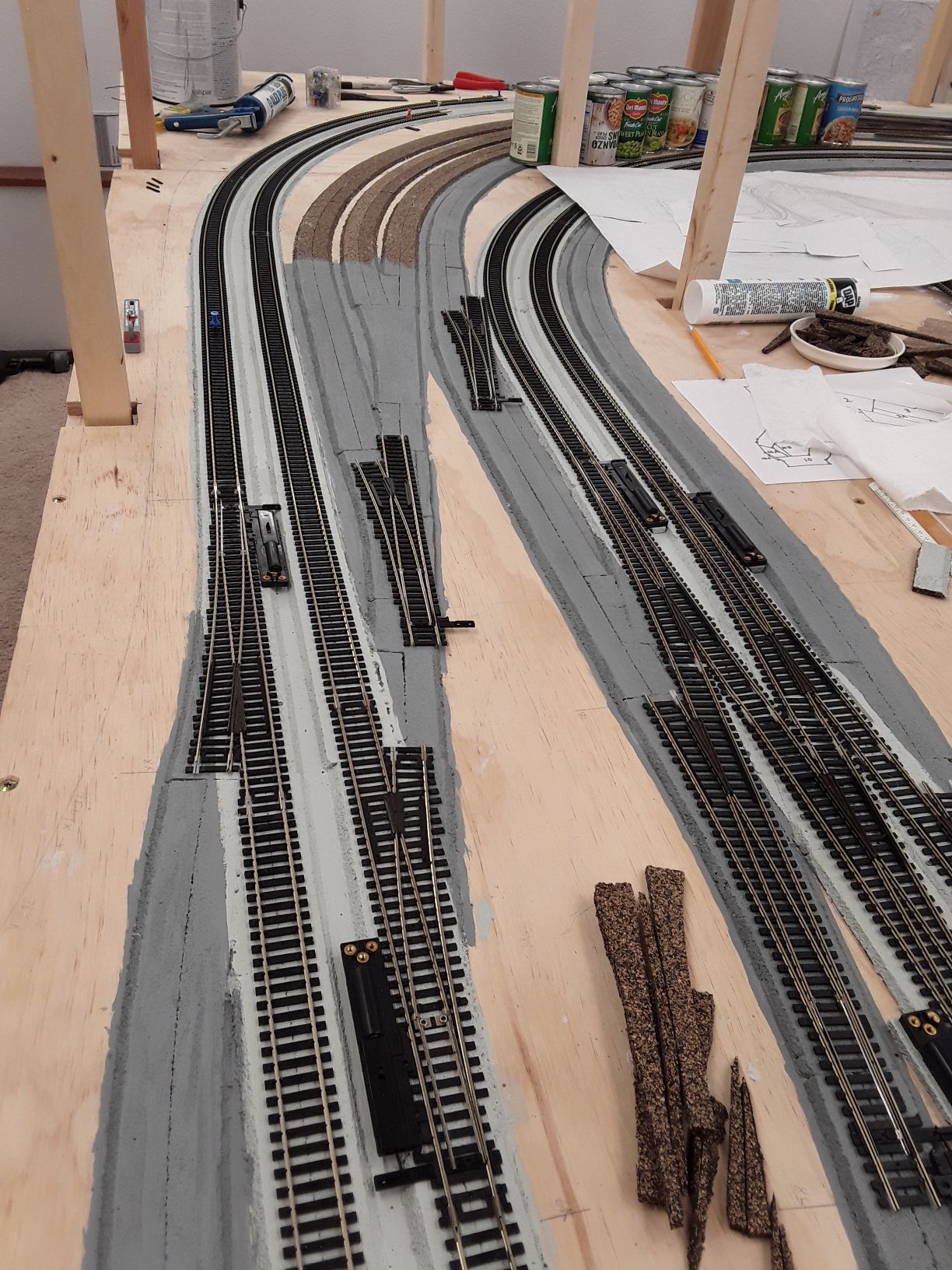
With the switch machine pads now in place, I photographed the area around the double-slip switch, showing where two Atlas switch machines will attach to the throw bars of the double-slip switch:


I'm going to have to invent some way for the switch machine arms to connect to the Shinohara double-slip throw bars, which are missing the holes that the Atlas throw bars have.

I'm anxious to see some trains running around the completed double tracks, so I plan to postpone the control panels and just add feeder wires and bus wires to all the track sections and temporarily connect them directly to DC power packs, so I can test all the mainline tracks.

I'll report back in another two weeks.


Sunday, August 28, 2022

UP's Erie-Built Diesels in Victorville, and Extending the Mainline Tracks beyond the Staging Room

Our selected Victorville locomotives this time are the Union Pacific's Fairbank-Morse Erie-Built passenger diesels.  Then the layout progress report will show the mainline staging tracks being extended beyond the staging room and back out into the main layout room.

The UP got their first Erie-Built ABA set in Dec. 1945 and numbered the units 50-M-1A, 50-M-3B, and 50-M-2A.  These looked different from all the later units, as they had step-down cab roofs with narrower windshields.

Here is this set in San Bernardino in Feb. 1946, when it was being tested with a freight train, as shot by Philips Kauke:


They found that the gearing was not right for either freight or passenger service, so they regeared them for passenger service in May, 1946.  These three units were renumbered in Aug. 1946 to 981A, 983B, and 982A.  All later units were geared for passenger service too, but they normally pulled the secondary trains.

Here are the same units with their new numbers in 1947 in San Bernardino with the eastbound Utahn, thanks to Jack Whitmeyer:


In Nov. 1947 the UP got two new AB sets, numbered 984A-986B and 985A-987B, and these had the later cab style, with no step-down roof and with normal windshields, like all subsequent Erie-Builts.

In March and April of 1948 the UP got two more ABA sets, with the cab units numbered 704-707 and the B-units numbered 704B and 706B.  At this time all the previous units were renumbered into the 700-series too.

Jack Whitmeyer shot a pair of Erie-Builts with a trailing Alco PA unit (they sometimes mixed the two diesel types together) eastbound on Sullivan's Curve, being helped by an FM H20-44 diesel:


Note the curving black exhaust screens that the UP added over the Erie exhaust stacks to catch cinders

Here we see unit 702 with trailing PB and PA units westbound through the Upper Narrows of Victorville, as shot by Fletcher Swan circa 1950:


Here is unit 702 again, leading two more Erie units this time, eastbound at Frost (just outside Victorville) with the LA Limited, as shot by Thomas Hotchkiss in March of 1951:


Jack Whitmeyer shot a set of Erie-Builts with a 4-8-2 steam helper eastbound on Cajon Pass:


Here is unit 707 leading the westbound Utahn at Summit circa 1950, as shot by Robert Hale:


Donald Duke shot unit 705 leading the eastbound LA Limited at Pine Lodge in January of 1951:


But in Feb. 1953 all of these units were transferred away to the Northwestern District and renumbered into the 650-series.  Here is unit 652 and two others in Omaha in Jan. 1955:


I don't have an HO model of the first Erie-Built set with the step-down cab roof to use in 1946 and most of 1947, but here's a photo of the Overland Models brass set:

I do have a Proto 1000 ABA set of later Erie-Builts, with two of the units shown here:


I see that Overland Models also made brass models of the UP's first set with the step-down cab roof, when the set had 700-series numbers:


It would be nice luxury to have a model of that first set someday!

My layout progress in the last two weeks has been to continue laying mainline staging tracks out of the staging room, through Section 8, around a curve into Section 1, and around a short curve into Section 2.

Here are the new mainline tracks (on the left) after being laid through Section 8 and partway around a curve into Section 1:


Then the tracks were extended around that curve into Section 1, up to the next turnouts (on the right):


The final step was to extend the mainlines past those two turnouts in Section 1 and around a short curve into Section 2, up to where the next turnouts will be located (at the lower right of the photo):


Now there is just one more tangle of turnouts to deal with, and the entire mainline loop around the staging deck will be complete!  

But then comes all the wiring of the track blocks and turnouts and control panels -- a whole new phase of layout construction to learn about and deal with!


Sunday, August 14, 2022

Santa Fe's 4-8-2 Locos in Victorville, and Continuing the Mainline Tracks through the Staging Room

Our featured locomotives this time are the Santa Fe's 4-8-2 steam locos that operated through or into Victorville in the postwar years.  Then we'll take a look at more progress in laying mainline tracks through my staging room and back out.

Between 1918 and 1924 the Santa Fe acquired 51 Mountain-type 4-8-2 steam locos from Baldwin, numbered 3700-3750 in the 3700 class.  

They were the main passenger locos until demoted by the 4-8-4s, and by the postwar years the Cajon Pass photos show them sometimes pulling extra sections of heavyweight passenger trains, but usually in general helper service on both passenger and freight trains.  The last photos of them in service there were shot in 1949.

Here's a rare color view of #3749 with a secondary passenger train by the Victorville depot in the postwar years, as shot by Chard Walker:


Here we see #3746 helping 4-8-4 #3758 with an eastbound troop train approaching Summit, thanks to Thomas Hotchkiss:


Here is #3740 helping passenger FT set #167 with an eastbound passenger train at Pine Lodge, as shot by Allan Youell in 1946:

2-10-2 #3013 and 4-8-2 #3723 were pushing behind an eastbound freight at Devore in Aug. 1947, when photographed by James Ady:


Here we see #3735 with the 2nd section of the westbound Chief, handling excess mail and express cars, at Lugo in March of 1946, thanks to William Barham:

Here is #3708 helping a westbound freight towards Summit, as shot by Jack Whitmeyer:


Finally, here is #3740 with the 2nd section of the westbound Fast Mail approaching Summit in June of 1949, as shot by Stan Kistler:


As for HO models of these locos, I have two of the Sunset brass models like this one, but painted #3742 and #3748:


Balboa also made a brass model, but I don't seem to have one of these:


As for layout progress on the staging deck, I continued laying the mainline tracks around the big curve in Section 10 and then into the straightaway in Section 11.

I got a bit better at soldering the rail joiners before curving the tracks, but the joints are not perfect yet. 

After four of the flextracks had been soldered and glued down on the curve leaving Section 10, I shot this photo showing the new tracks:
 
 
Then I added two more flextracks, and these were mostly on the straightaway in Section 11.  One of them had to be cut to meet the location of a crossover turnout for the return loop operation.  Here's a view of the new tracks in Sections 10 and 11:
 
 
The next step was to lay down two flextracks for the outer main as it crosses from Section 11 through part of Section 9 and into Section 8, leaving the staging room now, up to the turnout to where the future cassette-loading track will be located:
 
 
The final step so far was to cut and lay down two flextracks for the inner main in the same location, but between two turnouts.  In this view the pushpins are still in place while the caulk dries:


Insulated rail joiners were used where blocks end and where reversing tracks begin (insulated joiners on both rails for the reverse loop boundaries).

I'll keep working on adding more mainline tracks as I move around the layout.
 

Sunday, July 31, 2022

SP's Locos in Victorville, and Laying Mainline Tracks in the Staging Room

I'm back from a vacation trip and ready for another blog entry now.  This time I'll cover the unusual subject of Southern Pacific locos detouring through Victorville, and then I'll show some mainline track progress in my layout's staging room.

On rare occasions (but worth modeling) the SP had to reroute trains through Victorville and over Cajon Pass, due to washouts at various locations along their routes.  Chard Walker covers some of these events in 1951, 1952, and 1953 in Chapter 13 of his book "Railroading through Cajon Pass."

There was also an occasion in Nov. 1947 when the SP tested their GS-4 4-8-4 #4455 as part of the AAR rail stress tests at the curve at Cajon, as seen here:

This loco would not have come through Victorville to get to Cajon, but in 1952 some GS-4s did pull passenger trains through the town (see below).

On Aug. 29, 1951, SP E8 diesel #6018 led the Golden State westbound through Victorville and Cajon Pass, as  shot at Summit by Chard Walker:

On the same day, SP E7 #6001 led the eastbound Golden State over Cajon Pass, and unknown SP locos pulled the detouring Sunset Limited in both directions.

On Jan. 16, 1952, four more SP passenger trains were detoured over Cajon Pass, including the westbound West Coast, pulled by cab-forward 4-8-8-2 #4268, as shot at Summit by Chard Walker (a masterpiece):


On the same day, cab-forward #4229 helped GS-4 #4457 with the westbound Lark, and cab forward #4247 helped GS-4 #4455 with the westbound Starlight.  We have no photos of these pairings, but here's GS-4 #4449 when it ran east up Cajon Pass on May 8, 1989, during its side-by-side run with UP 4-8-4 #8444, as shot by Craig Walker:


One more SP detour on Jan. 16, 1952, was the westbound Owl behind passenger F7 #6239.

There were even more SP detours of both passenger and freight trains over Cajon Pass during Feb. 17-18-19 of 1953, but those were all pulled by SP diesels.  The passenger trains now needed a Santa Fe pilot engine for the Automatic Train Stop system then in effect.

For example, here we see Santa Fe 4-8-4 #3759 as the pilot engine for SP's eastbound Golden State behind E7 #6003 at San Bernardino, as shot by Jack Whitmeyer on Feb. 17, 1953:


I'll just summarize the other 11 trains that ran through Victorville during those three days of detours in 1953.  The SP passenger trains were usually pulled by E7s, plus one E8 and one F7.  The Santa Fe pilot locos were passenger F3s (AB sets) and 3751-class 4-8-4s.  

The SP freight trains were pulled by Black Widow F3s and F7s and didn't need pilot engines, but two of them did need Santa Fe helpers (a GP7 and a freight F7).

As an illustration, here's SP F7 #6157 set in Black Widow paint in Humphreys, CA, which looks a bit like Victorville in this view, as shot by Dick Kuelbs in Jan. 1956:


And here's SP passenger F7 set #6190 in Arizona:
 

So, there are excuses to have some fun by detouring SP trains through Victorville now and then.  Accordingly, I've collected many HO models of SP locos and passenger cars over the years, some of which didn't detour over Cajon Pass, as far as we know, but maybe they could have.

For example, I have a Key brass GS-4 4-8-4, like this one:


And I have an Intermountain AC-12 cab-forward, like this one:


And I have Proto 2000 models of SP E7s:


And a full set of Proto 2000 F7s in Black Widow paint:


I even have a Broadway Limited E7 set in the 1947-49 Golden State paint scheme, for unauthorized detours through Victorville:


I won't bother showing any other SP models I have, such as PAs and GP7s, but I do like the SP.

 A couple of weeks ago I made some progress in laying more mainline tracks in the staging room, extending past the tangle of turnouts that had slowed me down the previous week. 

The first nine feet of tracks were mostly on a straightaway, so that was fairly easy to do.  Here we see the mainlines leaving the turnouts and running straight through Section 9 and starting to curve in Section 10:
 
The side tracks on the darker gray roadbed on the left have been there for well over a year.
 
Here's a view of the mainline curves as they enter Section 10, with the three E Yard side tracks ending at the left:

Then I attached the next two flextracks, which continued into the curves in Section 10, and soldered the rail joiners before curving the tracks.  I glued them down around the curves and shot another photo.  The tracks now extend halfway around the big 180 degree curves in Section 10, where they meet the end wall of the staging room:
 
 
The next step is simply to continue laying more flextracks around this curve and then back toward the other end of the staging room.