Sunday, June 25, 2023

Santa Fe's 3160-Class 2-8-2 Locos in Victorville & More Help with Structure Models

I had hoped to write this blog entry two weeks after my previous one, but I was so busy downloading, labeling, and emailing photos from my Europe trip that I had no free time.  That temporary hobby finally ended this week, so I can now write another blog entry, three weeks after my last one.

The locomotive topic this time will be Santa Fe's 3160-class 2-8-2s, which were very similar to the later 4000-class that we covered here previously (Dec. 12, 2021).  And my layout topic this time will be mostly about the friends who are helping to build structures for my layout.

During 1917-1920 the Santa Fe acquired 128 heavy 2-8-2 steam locos from Baldwin in the 3160 class (#3160-3287).  These arrived in batches with minor differences, and all were upgraded over time.  

They were scrapped during 1950-1956, but the last published photos I've seen on Cajon Pass were in 1952, when just one of them (#3243) was used during the June Spud Rush, when many diesels were sent to the Valley Division to help there.

Let's begin with a color shot of #3236 with a passenger special at Redondo in 1950:

Here we see 2-8-2 #3221 helping 4-8-4 #2924 with a westbound Shriner Special near Frost (just after leaving Victorville) in June, 1950, thanks to Frank Peterson:


G.M. Best shot this classic photo of #3236 in San Bernardino in Dec. 1948:


Here is #3243 by the San Bernardino sand tower in an undated photo:


Jack Whitmeyer photographed #3243 helping 2-10-2 #3889 with an eastbound freight at Ono in June, 1952 (the Spud Rush again):


Here we see #3243 with a westbound local freight approaching Summit in June, 1952, thanks to Robert Hale:


Here is the face of #3243 by the Summit depot, probably in June, 1952:

Finally, here's a color shot of #3243 again, approaching Summit with a westbound local freight in June, 1952, thanks to Jack Whitmeyer, who was in the same photo line as Robert Hale (two photos back):

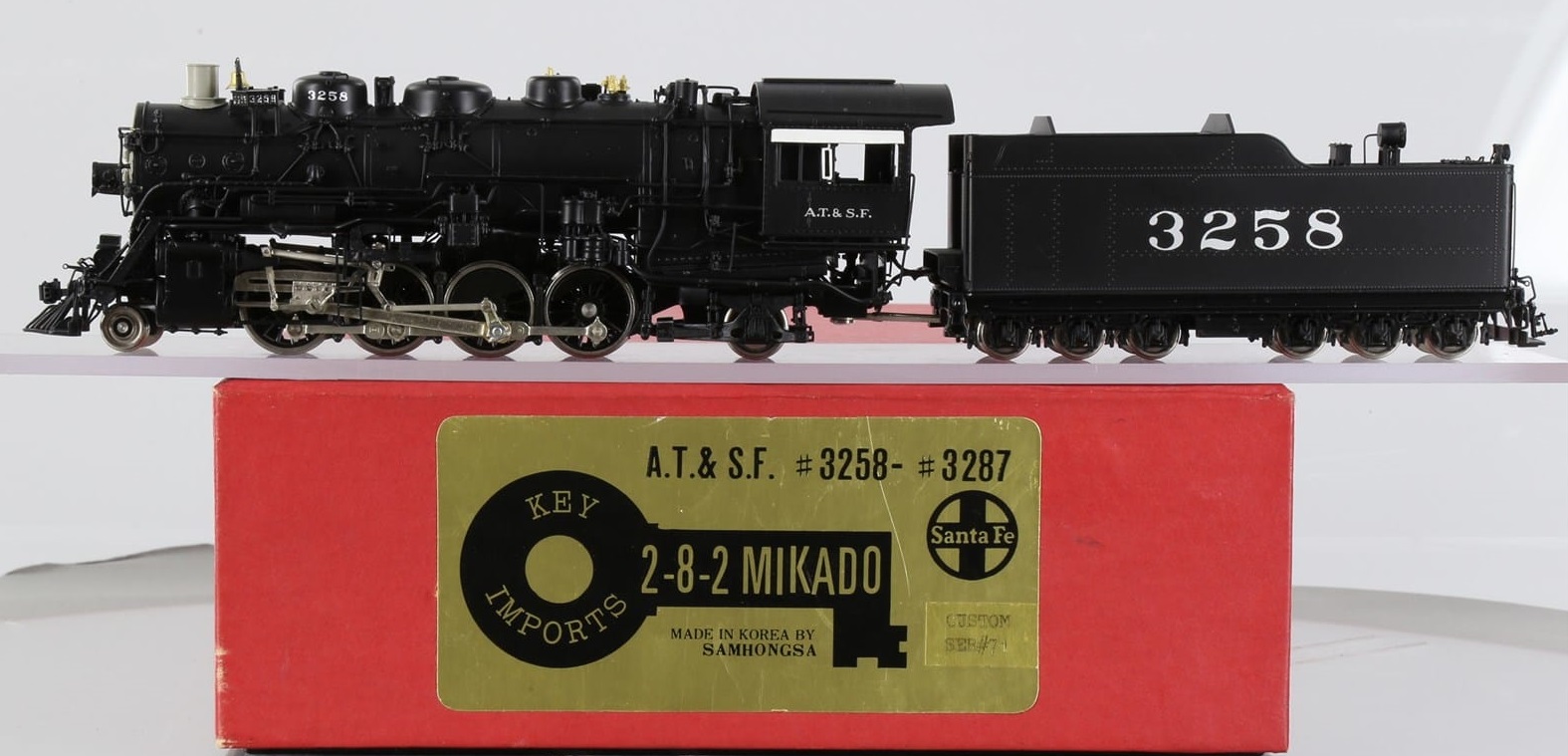
There have been quite a few HO scale brass models of various versions of these locos (along with the similar 4000 class) over the decades, such as by PFM in 1962-63, Sunset in 1977, Key in 1988, and Sunset again in 1992, and I have a few of them.

Here is the early PFM brass model of an as-built 3160-class loco (with a coal tender):


Here's a 1978 Sunset brass model with the rare
"trident-shaped" feedwater heater:

Here's a later (1992) Sunset model of the 3160 class:

Finally, Key made three versions of the 3160 class in 1988, including this example:

Now let's turn to my very slow layout progress (due to my temporary hobby of sending out Europe trip photos instead).  But there was good progress by my friends on building structures for the layout.

My newest helper, Craig Wisch in Victorville, who had completed a nice HO cardstock model of the old jail in Victorville, and who had suddenly disappeared from our frequent email discussions as of May 25, was later found.  It turns out that he had accidentally blocked all emails from me.  Jim Coady, who writes to both of us, got us back in touch after about two weeks.

Craig has made visits to the Victorville Switching Station in the Lower Narrows to get photos and dimensions of all the sides.  Here's a photo of the prototype -- the building is called the Control House:


Craig initially began work on an S-scale cardstock model, as he usually does, but then he set it aside and is now working on an HO-scale model.  Here's an early view of the front side of his model, with the door and windows inset by 12":

Also, my local friend Don Hubbard has been adding more details to his beautiful model of the Texaco gas station that was beside Route 66 in the Lower Narrows.  Here are some recent views of his model -- first, the right side, with the delicate phone booth kit he built:


And the left side, with many detail parts added:


My local friend Bill Messecar has also been busy making pencil drawings of the two section houses and a shed that stood near the water tanks, as seen in this cropped view of a  Jack Whitmeyer photo:


We only have partial views of these buildings, plus footprint drawings and dimensions from the Water Service Records, but the key ingredient will be the board-and-batten siding on the buildings.

Bill is also interested in building the two steel water tanks to complete the scene, so I located my two old BH-Models kits for the 60' tall Santa Fe tanks (later Rix made a lot of the same kits).

As I said, my layout progress has been very slow.  But a couple of weeks ago my local friend George Chambers came over one morning to get me going again.

We decided to fill in all the gaps between the cork sheets that will support the staging yards.  I inserted latex caulk into the gaps, and he came long behind me to smooth them out.  George posed for a photo when we were done with the job:


Later I sanded the dried patches and then painted over them with gray paint.

A big job ahead of me is to build and wire the four mainline control panels that Don Borden drew in CAD for me, based on all the advice from my electrical expert, Tim Fisher.  Here's a recent photo I shot off all four panel drawings arranged on the floor:


I sent the drawings to Kevin Hunter at his Berrett Hill company, and he sent me back a total purchase list of Touch Toggles and related parts needed for all four panels.  I had sticker shock, so the new plan is to order just the parts for the simplest panel (C Tower) to spread out the costs and the work.  Better to practice on just one panel!

I hope to get back to my previous schedule of a blog entry every two weeks now.


Monday, June 5, 2023

Santa Fe's E-Units and DL-109 in Victorville & Getting Help with Structure Models

It's been almost two months since I've been able to write a blog entry here, as my wife and I were busy with a three-week tour of Europe (our first time) -- we visited London, Paris, Rome, Florence, and Venice.  Near the end, we both came down with COVID, so we've been slowly recovering from that since we got home.

I'm getting down to the bottom of the barrel as far as which postwar Victorville locomotives I can cover here, but I'll cover some early Santa Fe passenger diesels that only made rare appearances in Victorville during the postwar decade -- the EMD E-Units and the Alco DL-109.  Then I'll cover some HO structures that some friends have been working on for my Victorville scenes.

Let's start with Santa Fe's E1 streamlined passenger diesels (#2-9, and some had B units).  These were not pulling trains over Cajon Pass during the postwar years, but they were pulling the Golden Gate trains on the Valley Division and the San Diegan trains out of Los Angeles.  

Reportedly, they were sent to San Bernardino for their annual inspections, so once a year the E1s from the Valley must have run through Victorville on their way to their inspections and back.

Here's a shot of E1 A-B set #4 in Fresno in about 1948, from the Joe Taul collection:


In recent years Broadway Limited made some very nice models of the Santa Fe E1s, including the postwar version, which I have:

Our next Victorville E-units were the E6s (#12-15, some with B units), which actually did pull passenger trains through Victorville into 1946, as seen here in Victorville with #13 pulling the eastbound El Capitan in Jan. 1946, thanks to Fletcher Swan:

Walthers Proto 2000 made good HO models of these locos:

Later Broadway Limited also made very nice models of the E6s:


Our next Santa Fe E-units were the E8m's (#80-87, some with B units), which were rebuilt from the E1s in 1953.  As with the E1s, the E8m's were pulling the Golden Gate trains on the Valley Division and the San Diegan trains out of Los Angeles.   

They were sent to San Bernardino for their annual inspections, so once a year the E8m's from the Valley must have run through Victorville on their way to their inspections and back.

Here is one of those E8m sets, #82-81A, with the Golden Gate in Fresno in the mid-1950s, as shot by Paul Taul:


Jack Whitmeyer shot one of the recently-built E8m's, #4 (right before it was renumbered into the 80 class) in San Bernardino:


Also, here is an undated shot of #80 in the San Bernardino shops area from page 441 of Worley's "Iron Horses of the Santa Fe Trail":


Proto 2000 made an E8m cab unit, but I don't think they made a B unit:


Broadway Limited later did make both an A and a B unit for the E8m:


Our final passenger diesel that made rare appearances in Victorville is the Alco DL-109/110 (#50).  By the end of WW2 they were assigned back east, but DL-109 #50 was sent west for shopping in San Bernardino in Sep. 1951.  

It was released from the shops and was photographed briefly while testing in San Bernardino in April 1952.  So, it would have run through Victorville once in each direction then (Sep. 1951 and April 1952).

Here's a photo of #50 in the San Bernardino shops area at that time:


In April of 1952 R.P. Middlebrook photographed #50 at the San Bernardino depot:


Jack Whitmeyer got a similar shot at about the same time:


Walthers Proto 1000 made a model of the A unit, but it has an extra window behind the warbonnet that should not be there (but as the photos show, the windows had become louver sets by this time anyway):


The Hallmark brass set included both the DL-109 and the DL-110, and it had the correct side windows as originally built:


I recently got a painted set like this, so my unpainted set is now for sale to anyone who wants one.

I haven't made any progress on my layout while I was gone and while I've been recovering, but some friends have been busy building structures for my Victorville scenes.

Bill Messecar is interested in helping with more structures for my Victorville scenes, beginning with a third pumphouse to match the other two he built.  Then he'd like to work on some drawings of what the two section houses might have looked like, based on partial photos and his knowledge of Santa Fe section houses.  Then he would work on scratch-building them for me!

And on April 12 I heard from a gentleman who's about my age named Craig Wisch, who lives in Victorville and has been reading my blog.  He has previously been building S scale models of some local buildings using cardstock and paper.
 
He offered to start building some HO models for my layout, so we looked first at two buildings that are still standing there in town: the old jail and the office of the Victorville switching station at the Lower Narrows.  He began visiting those buildings and getting measurements and detailed photos.  His plan was to assemble them and then ship them to me in boxes.
 
By May 12, Craig had completed a nice HO cardstock model of the old jail.  Here's the actual jail:
 
 And here is Craig's beautiful new cardstock model:


My long-time friend Don Hubbard has been working on a model of the Texaco gas station that was on Route 66 in the Lower Narrows during my time period.  Here's a good photo of the gas station just before the gas pumps were installed:


Don began with a Piko kit for a similar gas station, but he has done a lot of mods to make it closer to the prototype.  Here's a photo of his early progress, as of May 14:


Here's Don's further progress as of May 28, after Bill Messecar had added tarpaper roofing to the garage section:


Here's one more update as of June 4, after some lettering and decals had been added:
 

Don will continue to add details (such as gas pumps) in the days to come.
 
After completing his model of the old jail, Craig Wisch turned his attention to the electrical switching station that still stands in the Lower Narrows:

 
He drove out there and shot photos of all sides of the building and got some dimensions.  He also began discussing ideas for how he might be able to build a cardstock model of the large Rainbow Bridge someday!  
 
But then on May 25 he suddenly dropped out of sight in the middle of our good email conversations, so I'm worried about what might have happened to him.
 
I still need to get to work and study the drawings of the four mainline control panels that Don Borden drew for me, so that we can finalize them and get to work on building them.  I also need to get back in touch with Kevin Hunter for ordering a lot of the Touch Toggles we plan to use.

And I'll try to get back to work on the actual layout in the next two weeks!


Sunday, April 9, 2023

UP's GP7s and GP9s in Victorville & Painting More Cork Sheets for Staging

This time we will look at the Union Pacific's EMD GP7 and GP9 diesels in action through Victorville, and then we'll see the progress in finishing the painting of all the cork sheets for the staging yards.

The UP was later than the Santa Fe in acquiring a large fleet of GP7 and GP9 road switchers to replace their earlier helper diesels and then their road diesels (Alco FA-FB sets and EMD F-unit sets).  

They didn't get their 30 GP7s until Feb. through Oct. of 1953.  They were very briefly numbered #700-729, but they were quickly renumbered to #100-129 in Oct.-Nov. 1953.

Here we see GP7s  #119 &114 helping a set of PAs with an eastbound passenger train entering Summit, thanks to John Munson:


Lewis Harris photographed GP7s #109 & 106 helping another set of PAs with an eastbound passenger train out of San Bernardino in April, 1954:

Here we see GP7s #109 & 106 again, this time helping a mixed set of a PA and two Erie-Builts with an eastbound passenger train as it approaches Summit in 1954, as shot by Don Sims:


During 1954 through 1957 the UP acquired a very large fleet of GP9s, along with some GP9B units.  They got GP9-GP9B pairs #130-204 during Feb.-April, 1954, and they got GP9s (without B units) #205-249 during Jan.-June, 1954.  Then #250-299 arrived in Aug.-Sep. 1954

Here's a nice shot of GP9 #130 helping the eastbound City of Las Vegas (the Aerotrain) into Summit in Jan. 1957, thanks to Allan Styffe


Here's a badly cropped Robert Heuerman shot of a GP9 ABBA set led by #140 as it descends with a westbound freight through Blue Cut in 1955 (this was a typical use of these GP9-GP9B sets, as four-unit road power):


Here we see another GP9 ABBA set, led by #147, as it descends with a freight through Keenbrook in May of 1956, thanks to John Shaw:


The GP9s were also used as road switchers.  Here is #173 and a partner pulling the eastbound Leon Turn toward Summit in Jan. 1955, as shot by Thomas Hotchkiss:

Here's an ABA set of GP9s with a westbound freight between Hesperia and Lugo, led by #273 in Jan. 1956, as shot by Thomas Hotchkiss.  This is probably the Leon Turn again:


Here we see an ABB set of GP9s, led by #279, with an eastbound freight at Cajon station in April, 1955, thanks to Bob Kern:


Finally, here is GP9 #294 helping the eastbound Aerotrain to Summit in 1957, as shot by Thomas Hotchkiss:


In July-Oct. 1957 (just after my time period) the UP got a final set of GP9s and GP9Bs, #300-349 and #300B-349B.  I will skip any photos of those here.

There have been plenty of HO models of UP GP7s and GP9s.  I'm careful to get the models that have the early slogans on the cabs, such as "Road of the Streamliners," but some the photos I found on the Web have later slogans.

Here is a Proto 2000 model of a GP7, but with a later slogan:

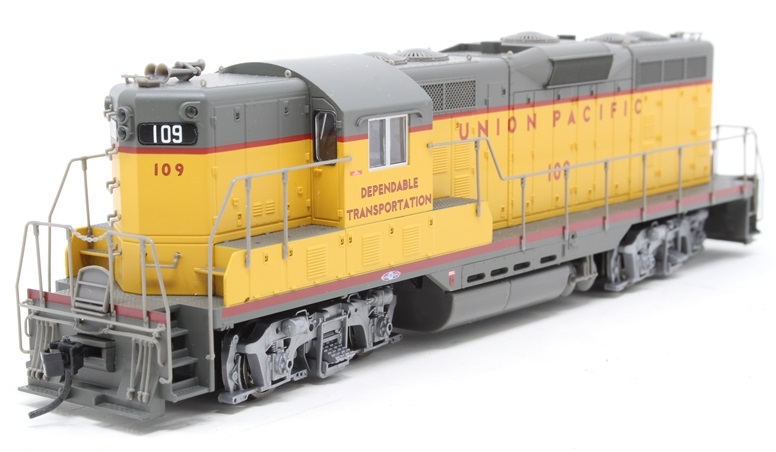
Here's the Walthers Mainline GP9:
 
And the Walthers Proto GP9:

Thankfully, Athearn Genesis made the GP9-GP9B pairs, as seen here (but mine have the early slogans):


Let's turn now to the slow progress on my layout.

When we left off, Bill Messecar had painted many of the cork sheets on the east half of the main peninsula of the benchwork.  But one of the painted cork sheets later warped upward due to absorbing the wet paint and not having enough glue to hold it down, and when I tried to insert more glue under it, the cork tore apart.  So I dug the whole sheet out, sanded the wood smooth, and glued down a fresh cork sheet, which I later painted.

I also crawled into the center pop-up area of the peninsula and painted the rest of the cork that was out of reach from the aisle.  The replaced sheet is in the foreground of this photo of me at work
 
 
One day that week was spent on a road trip north to Mukilteo to meet with my brass painter.  I hadn't been there in over a year, so I picked up the locos that he had painted or lettered or re-geared, and I left him with a few more brass locos to be painted.

One of the locos that he had painted was the UP's first gas turbine, #50, and I posed it on the inside mainline, where you can also see the painted cork on the east half of the peninsula:


My next layout work happened this weekend, when I painted most of the cork sheets on the west side of the peninsula:


Then I painted the rest of the cork sheets by crawling into the center of the peninsula.  At the same time, I trimmed some cork edges that were hanging over the edge, and I cut and glued some filler cork pieces where there were gaps

Here's the current view of the west half of the peninsula, as seen from the other end of the room (the most recent paint was still wet):


Most of my time has gone into preparing for several busy weeks of family events. This will be my last report for at least the next month.  When I resume the layout work, there will be a lot of electrical jobs to do, to get the inner mainline running and to start building the four mainline control panels for the lower deck.