Sunday, January 23, 2022

UP's 4-8-2 Locos in Victorville, and Preparing for Track and Wiring

This time we'll look at Union Pacific's 4-8-2 steam locos in passenger and helper service in Victorville, and then we'll look at initial steps in preparing to lay roadbed and track on my layout and in planning to wire the layout for DC cab control.

In 1922 through 1924 the UP bought sixty 4-8-2 Mountain-type steam locos to speed up their passenger service.  They were numbered 7000-7039 for the UP and 7850-7869 for their Los Angeles & Salt Lake route through Cajon Pass.  The LA&SL locos were oil burners, and some of the 7000-class locos were later converted to burn oil too.

By the time of the postwar years that I model, they had been demoted to pulling secondary passenger trains and to helper service on Cajon Pass. Here's a beautiful Chard Walker photo showing #7019 as a helper in Victorville during UP's 1950-1951 return to using steam on Cajon Pass:

Note the two-tone gray paint with the silver stripes, which was used starting in mid-1949.  Also note the white Texas Quarries granite mill roof and the cliffs of the Upper Narrows in the background.

These locos were active on Cajon Pass (and in Victorville) until sometime in 1948, when they were replaced by diesels, but they returned during June, 1950 until Oct. 1951.  They were not seen there again after that.

UP #7019 was one of the two UP 4-8-2s that returned to Cajon Pass during 1950-1951. The other one was #7859, as seen here in Victorville in a June, 1951 photo by Stan Kistler:


Here is #7852 about to pull a secondary passenger train east from San Bernardino in Dec. 1948, as shot by John Lawson (this loco was also in two-tone gray, but it probably had yellow stripes, which was the style from 1947 until mid-1949):


Here we see #7852 again, this time double-heading with 4-8-4 #803 on the westbound Utahn just west of Summit in July of 1948, as shot by Chard Walker:


Jack Whitmeyer shot this color photo of #7019 after it had helped a train to Summit in June of 1950, at the start of the UP's return to steam:

Finally, here's a dramatic shot by Donald Duke, showing #7019 helping an Alco PA unit and the eastbound Los Angeles Limited around Sullivan's Curve in the heart of Cajon Pass in June of 1950:


There have been quite a few HO models of these locos over the years.  For example, here's a Westside brass model painted with silver stripes:


And here's an Overland brass model, factory painted with silver stripes:


Broadway Limited, Inc. produced several factory-painted versions of these locos in styrene.  Here is one in UP's pre-1947 black paint scheme (also used in 1952 and later):


Here is a BLI model with the 1947-1949 yellow stripes:


And here is a BLI model with the mid-1949 into 1952 silver stripes (they were painted black again starting in 1952, after they had left Cajon):


Seeing these models has inspired me to check on which ones I have and to get at least one of them renumbered to #7019 or #7859 for use during 1950-1951.

Now let's turn to the fairly slow progress on my layout.  I found a carpet store that sells sheet cork 3/16" thick in 2' x 3' sections, so I bought 20 sheets to cover my staging yards.  

I also got outdoors for a day to cut some plywood pieces to fill the four holes where legs used to be (they were in the way of some staging tracks) and a triangular shape so the tracks can cut the corner by the post, as seen here after I built a frame for it and installed it (the paper rectangles were the patterns for the leg holes):


I got a lot of advice from Tim Fisher (again) on how to wire my layout and my control panels for DC cab control, after briefly reconsidering DCC (but I have way too many DC locos to convert, and I've always wanted to use DC cab control).  I sent him this photo of some of my wiring supplies (except for soldering tools) -- I've been using #22 feeder wires and #14 bus wires so far:


There will be one dispatcher panel for each level, for the mainline blocks and turnouts, and several local panels for operating local blocks and turnouts.  We agreed that there should be four cabs, with one of them only for the upper level local switcher.  Here is my drawing showing in red where the dispatcher panels could be located, just inside the doorway to the helix room:


One day I took a break and met my friend Bill Messecar for lunch, and he gave me back his model of the Victorville depot after a minor fix, and the first of three models of the Victorville pump houses he's building for me, as seen here:


Part of this week was devoted to getting advice from another Tim, this one being Tim Repp, an old friend from the Boeing Employees Model Railroad Club.  He has been building a layout that uses DC cab control and that also uses magnetic uncoupling rather than picks, so I wanted to see how he does it.  

He's over an hour away in Gig Harbor, and here he is, standing inside his layout near his main control panel:


He showed me how he does his uncoupling and how he built his control panels.  I took a lot of notes and shot some photos, including this one showing his lower deck staging panel (he uses radio buttons instead of rotaries, as there are only two cabs per panel):


Many thanks to Tim Repp for sharing his methods, and for discussing them later with Tim Fisher and myself via emails.  Tim Fisher then sent me a handy shopping list for all the switches, buttons, rotaries, terminal blocks, etc. that I should start acquiring for my control panels.  I also need to get busy and work out the block boundaries for the lower deck and the layout of the control panels.

I did order and receive a lot of Atlas switch machines, both manual and powered, for the many turnouts on the lower deck.   Here's a photo I shot of some of the track and roadbed supplies I've acquired so far:


So, I'll keep on pressing forward, hoping to begin laying some roadbed and track before long, and hoping to figure out the wiring and control panel designs.

Sunday, January 9, 2022

Santa Fe's Passenger FT Diesels in Victorville, and Finalizing the Staging Track Plans

Our featured Victorville locomotives this time will be Santa Fe's EMD FTs in passenger service.  We'll also take a look at the final (I hope) changes to the staging track plans.

During April through August of 1946 the Santa Fe converted 11 sets of their 4-unit FT freight diesels to passenger service and repainted them into Warbonnet paint.  They kept their numbers of 158 through 168.

Here is FT set #159 rounding the curve at Cajon with the eastbound Grand Canyon Limited, as shot by Chard Walker in Sep. 1948:


In this next view by Jack Whitmeyer, an FT set is bringing an eastbound passenger train through Victorville, with the depot at the right and the Upper Narrows cliffs in the distance:


Here we see FT set #162 passing under a large signal bridge:


In July of 1947, Chard Walker shot FT set #158 leaving Victorville westbound through the Upper Narrows with the Grand Canyon Limited:


Stan Kistler shot FT set #159 with the eastbound Chief climbing Cajon Pass in Nov. 1947:


In May of 1948, when the Santa Fe had acquired enough passenger F3s, they converted three of their passenger FT sets back to freight service and colors.  Then in July of 1950 they converted almost all of their other passenger FTs back to freight service and colors.

Set #168 stayed in passenger service until 1954, but it was split into two A-B sets, #168LA and #415LA, to pull shorter trains.  Here is #168LA in San Diego in 1954, as shot by Harold Williams:


Between passenger assignments, these A-B sets sometimes served as helpers on freights, as seen here on Cajon Pass in a shot by Robert Heuerman:


There have been several HO models of these locos, with the first ones by Stewart (these are the ones I have).  Note the correct broad curve of the Warbonnet on the roof:


Later they were also made by Intermountain, with a sharp point on the roof:


Division Point also imported a brass model:


Bachmann made only an A unit, and its Warbonnet was too short on the side.

Bill Messecar has been helping me by scratch-building more Victorville structures.  He has recently completed the first of three beautiful pump houses with derricks that were beside the Victorville water tanks:


And Tim Fisher has been helping a lot by recommending final improvements to my track plans.  I'm up to Version 5, which now has the A Yard track curves evenly spaced, and which now has a new C Yard with six tracks instead of five.

I saw a chance to redraw the C Yard when I removed two 2x2" legs that were in the way and were not needed.  I also removed two 2x4" legs that were in the way of curves elsewhere.  I had planned to move them nearby, but the layout stands just fine without them, now that the sections are all bolted together.  My other minor benchwork changes will have to wait until next week.

Here is the new straight-line schematic for Version 5:


Here are the new storage lengths and radii of all the storage tracks:

Here's the revised track plan for the main peninsula area:


And for the turntable area:


Some of this past week was spent counting the various turnouts I'll need for the lower deck:

Total turnouts needed = 72

Manual turnouts (close to the aisle and not part of a mainline) = 20
Powered turnouts (using Atlas above-table machines) = 52

#6 Left turnouts = 36
#6 Right turnouts = 27
#8 Left turnouts = 2
#8 Right turnouts = 7

I found that Atlas code 100 #6 turnouts are sold out everywhere until they restock, but I do have some in my inventory (not nearly enough).  I have way too many #8s in stock, because my plan was to use #8s to enter and leave each yard track, until Tim Fisher said I can use #6s for that, so I did,  Maybe some #8s will fit where I drew #6s, we'll see.
 
I have plenty of cork roadbed for the mainlines, but I need to get a lot more 3/16" sheet cork for the yard areas.

Here is some of the inventory of what track supplies I have in stock:

Atlas code 100 flextracks - 223

Atlas code 100 #6 Left - 9  (need 27 more)
Atlas code 100 #6 Right - 4  (need 23 more)
Atlas code 100 #8 Left - 14  (have 12 extras)
Atlas code 100 #8 Right - 15  (have 8 extras)

Left Manual switch machines (#62) - 17 
Right Manual switch machines (#63) - 7 (plus 2 used already)
Left Remote switch machines (#52) - 22  (need more)
Right Remote switch machines (#53) - 24  (need more)

Atlas Snap Relays (#200) - 12 (DPDT for powering frogs)

So, all these numbers will help guide my upcoming orders for more supplies to lay and wire the staging mainlines and then the yards.  I'll report back in two weeks.

Sunday, December 26, 2021

UP's Alco FA-FB Diesels in Victorville, and Improving the Staging Yard Designs

This time we'll take a look at the Union Pacific's Alco FA-1 and FB-1 mainline diesel freight locos that operated through Victorville, and then we'll look at the final improvements to the lower deck staging yard designs.

From June of 1947 through September of 1948 the UP acquired 44 FA-1 cab units and 44 FB-1 booster units, enough to assemble 22 ABBA sets of 6,000 HP per set, in its effort to dieselize its California mainline freight operations.

Here is UP FA-FB set #1603 climbing the grade westbound at Frost, just after leaving Victorville, as shot by Frank Peterson in Oct. 1950:


The sets acquired in 1947 were numbered in the 1500-series, but they were all renumbered to the 1600-series during 1948.  Most photos show them in their 1600-series numbers.

Here is set #1603 again in Oct. 1950, this time stopped beside the Victorville Wye (see the boiler house and elevated fuel tank at the left), waiting for UP steam helper #5092, a 4-10-2, to be added for the climb up Cajon Pass:


Here we see an ABBA set of FAs and FBs heading west past the Riverside cement plant at Oro Grande, heading to Victorville, as shot by Donald Duke circa 1950:


Here is UP FA-FB set #1611 waiting to depart the B Yard in San Bernardino, headed east to Cajon Pass and Victorville in April 1950, as shot by Jack Whitmeyer:


Here's another UP FA-FB set, working hard as it climbs west out of the Upper Narrows at Victorville, as shot by Donald Duke:


Here's one final action shot as FA-FB set #1603 climbs westbound out of Victorville's Upper Narrows in Oct. 1950:


The UP's FA-FB sets operated over Cajon Pass from 1947 until sometime in 1954, when they were replaced by new GP9s from EMD.

There have been many HO-scale models of the UP's FA-1s and FB-1s.  Here are the Walthers Trainline models, which used to be made by Train Miniature:

Note that models have been made with the early 1500-series numbers as well as the 1948+ 1600-series numbers.

Here are the Proto 2000 models:


 And here are the HO models from MTH:


Rapido is now planning to make super-detailed models of these locos.  My models came from both Proto 2000 and Train Miniature.

Turning now to progress on my layout design for the lower staging deck, I erased and drew some new stub-ended yards and moved some crossovers to make an improved Version 4 track plan, which I hope is the final design.

I've checked that each train and each loco can get to where it needs to go.  Sometimes there will be back-up moves, such as backing a train into a stub-ended storage yard after its run.

Here is the revised track plan for the main peninsula:


 Here is the revised turntable area drawing:


 And here is the revised helix room drawing:


Here's Version 4 of the straight-line schematic drawing of the tracks, with new labels for some of the yards (the old D Yard in the helix room is now called the F Yard):

I remeasured the storage capacities for all the tracks that had changed, and here are the new numbers:
 

I think my next steps are to move a few legs on the benchwork, add a plywood triangle in one spot, sand down the joints between sections, and add shims and wood filler between some joints.  Then the track lines can be drawn on the plywood.

Sunday, December 12, 2021

Santa Fe's 4000-Class 2-8-2s in Victorville, and Revising the Staging Yard Designs

This time we'll take a look at Santa Fe's heavy 4000-class 2-8-2 steam locos, some of which operated in Victorville, and then we'll discuss more revisions to the staging yard designs.  I was gone on vacation this past week, so not a lot got done since last time.
During 1921-1926 the Santa Fe acquired 101 heavy 2-8-2 Mikado locos, numbered 4000 to 4100.  These were a continuation of the previous 3160 class, which had 128 locos.  

Here is one of them, #4068, in action:


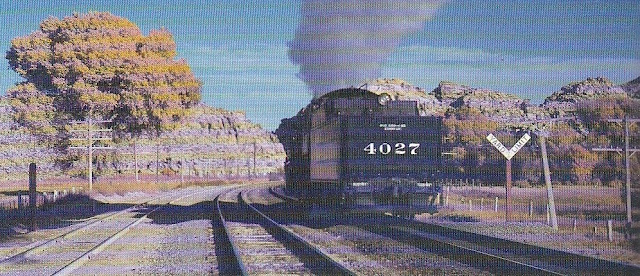
During the postwar years on Cajon Pass, these locos normally served as helpers.  Here's a Chard Walker photo of #4027 as it returns to Victorville after helping a train to Summit in Nov. 1948 (note the Upper Narrows in the background):

Here's another Chard Walker photo, this time showing #4025 working in Victorville, with the stock pen in the background:


In June of 1950 Stan Kistler photographed #4010 as it helped a Green Fruit Express train with F7s up the grade above Cajon station:

On the end of that same train, #4009 was a rear-end helper.  Here we see #4009 at rest in the postwar years:


By the way, #4000-4014 were a little different from the later ones, as they had Hodges trailing trucks instead of the later Delta trucks.  Locos that came with one sand dome later got a 2nd one.  Most got an extended cab after 1940, and most eventually got a modern Elesco feedwater heater.

Some of these locos operated as helpers in Victorville until about mid-1951, when the Santa Fe stopped using them in this area.  They were also sometimes used on the local freights.

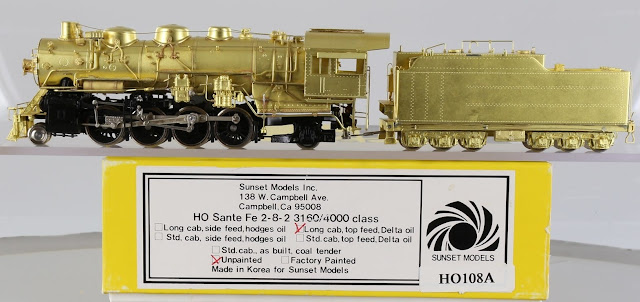
There have been HO scale brass models of various versions of these locos over the decades, such as by PFM in 1962-63, Sunset in 1977, Key in 1988, and Sunset again in 1992, and I have a few of them.

Here's an example of one of the Key models:


And here is one of the Sunset models (note the variations on the box label):


In the last year or so, Broadway Limited Inc. has produced a nice styrene model of the postwar version of #4015-4100, such as this model of #4023:

These are still on the market, with lower prices now, so I might want a second one!

Before I went on vacation, I made some revisions to my staging track plan.  Following more advice from Tim Fisher, I removed most of the stub tracks that came off backward from another track, as they are not worth the cost of the turnouts to connect to them.  I also revised some of the connections among the tracks that feed into the return loop.

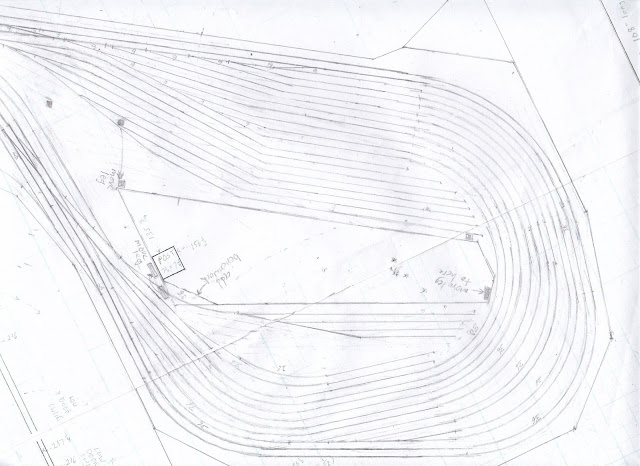
The plans are now up to Version 3.  Here is the revised main peninsula plan, with the large, curving A Yard of double-ended tracks, and the adjacent B Yard with stub-ended tracks: 


 And here is the revised turntable area:


 I also revised the straight-line schematic to show the current plan:

Finally, I remeasured the storage lengths of the all the tracks that had changed.  Here is the current list of storage tracks and their lengths and radii, if any:


I'm still discussing any further improvements with Tim Fisher, along with an operating scheme for how the staging tracks would be used.  Here are some thoughts:

Use the double-ended 10-track A Yard for freight trains, and use the stub-ended 8-track B Yard for passenger trains.
Use the turntable tracks and the track that loops around it (Track S1) for storing steam locos, and use the C Yard, D Yard, E Yard, and R Yard (all shorter tracks) for storing sets of diesel locos (F-units, E-units, Erie-Builts, PAs, FAs, etc.).

Keep tracks T1 and R1 open as switch leads into the A and B Yards.

Maybe add one more track to the C Yard and one more to the R yard.
We are thinking that a mainline operator should take his assigned loco to his train, then take his train up the helix and through Victorville on the upper deck, return down the helix, return the train to its empty track, and take the loco back to its storage track.  
 
The cabooses would be left on the freight trains in the yard.  The passenger trains would be backed into their stub-ended storage tracks.

Consider eliminating some of the mainline crossovers, and maybe run left-handed on the lower deck mainlines, and maybe have the trains make a trip around the lower deck before they climb the helix and when they return from the helix.

I'll get back to work on the design this coming week.